This calculator illustrates the impact of rising rates and the risk of holding Bond ETFs vs. Cash. It provides a high-level view on Government Bond ETF Total Return with (i) negative impact from rising interest rates (e.g. triggered by inflation) followed by (ii) positive impact from central bank intervention in a recession scenario.
Run the calculator and look at the Bond ETF price. Compare that to the initial price you pay for the ETF in the inputs e.g. 100 — the amount you would have if you kept cash instead of investing in a Bond ETF.
Using simplified assumptions, it is possible with Constant Maturity Bond ETFs. Price falls due to rising interest rates are temporary. Over time, they will be offset by higher coupons.
Because Constant Maturity Bond ETFs keep a constant maturity range, the required holding period is significantly longer than traditional Bonds. If we proxy it by keeping a constant duration, this holding period can be up to two times ETF duration if rates continue going up (but can be shorter depending on when rate hikes stop).
Rising yields are nominally beneficial if your investment horizon is longer than two times duration (in years). At that point, the higher coupons will offset any negative price impact from rising rates.
Yes, it is still problematic in real terms, because rising rates are usually driven by high inflation. BUT, the Bond ETF price (which includes distributed and reinvested coupons) and cash will be equally affected by inflation and the idea of the tool is to compare them on relative basis.
Bond ETFs provide protection in a deflationary/recession scenario — represented in the simulator by an illustrative ‘pop’ effect on prices when Central Banks cut rates. This can be beneficial when Equities are in a Bear Market and investors use rebalancing, selling Bond ETFs and rotating into cheaper Equities.
On their own, they tend to decrease in price more with rising rates. But within a portfolio, higher duration Bond ETFs bring more potential rebalancing benefit. E.g. if an ETF has a duration of 8, then for a 1% change in interest rates, the ETF price will change by approximately 8%.
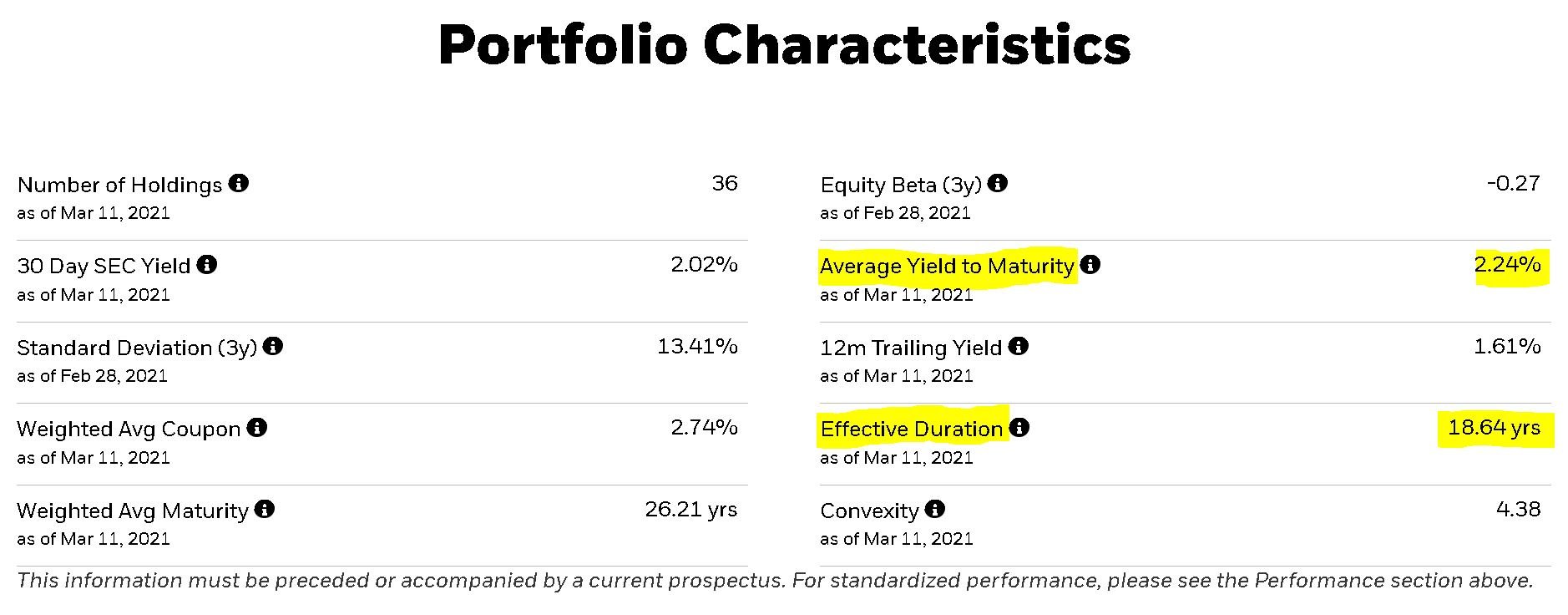 Example of key ETF characteristics for projection
Fill in the inputs below using data from your ETF provider. The calculator will update results in real time.
After entering your inputs, the results update automatically. Here is what each output means:
Most ETF Bond Funds are typically managed to keep average maturity within a constant range. This objective is proxied by keeping duration constant. In this simulator, the ETF re-balances at each period into newly issued Government Bonds issued at par. Most recent bonds issued by governments tend to have coupons very close to the current yield. The calculation assumes the asset manager is reinvesting coupons/dividends (conceptually like Accumulating ETFs, e.g. in Europe). The purpose is to capture in the price a total return.
If relevant, to assess the likely impact the Initial Yield should be taken from current local Government Bond Yields in Investor’s Domicile/Currency Area and broadly matching the ETF’s duration. Assumes interest rate parity. Hedged returns are expected to broadly replicate the performance of local Bonds (Vanguard, April 2018 paper) albeit with additional diversification benefit.
The projection may be a slightly distorted proxy for Aggregate Bond ETFs. But since Aggregate Funds are predominately invested in Government Bonds the overall impact should be captured. Other risks include Credit risk (OAS) which plays a role and is not modelled here. Convexity impact is usually marginal, usually positive as MBS/Callable Bonds’ effect may be offset by larger impact of positive convexity Government Bonds in typical Aggregate Bond Fund. Thus, the simulator may also be (marginally) conservative from convexity standpoint (e.g. as of March 2021, iShares AGG ETF convexity is 0.1).
Central Bank rate cut is simplistic in this simulation and assumes a drop to the Recession Yield level within 3 months following a severe crisis (exogenous shocks e.g. COVID-19). It overrides any previous user rate hike assumptions and stops projection after calculating initial price impact. The lower the recession yield, the higher the price increase.
It is a proxy for ETF Effective Duration and/or OAD, should any Bonds have embedded options (assumed marginal, since most of optionality is credit related and this simulator is focusing on broadly mimicking Government Bond ETFs). Duration is assumed to be adjusted to ETF initial objective at end of each period. Assumes a parallel shock to the interest rate curve. Duration effect may be underestimating some positive price impact, e.g. for large interest shocks, very low/negative yields or/and high duration funds, as explained in the convexity section below.
No, they are excluded for simplicity of analysis and assumed to be of marginal impact.
This calculator takes a Total Return approach, reflecting reinvested coupons and price impact on ETF due to rising/falling rates. It simulates Constant Maturity Bond ETFs — these funds represent the majority of ETFs available to retail investors (e.g. Vanguard’s VCIT or iShares’ IEF for medium term investment horizon).
The calculator assumes a parallel shift in the yield curve. Convexity is also excluded from rate hike/cut impact. This calculator’s objective is to give a high level price impact guidance and return magnitude in a rising yield environment. It does not provide full benefit of holding the ETF, due to its sole reliance on duration. As such, the simulation is conservative from Investor’s perspective, as most government bonds are usually characterized by positive convexity.
The actual price/return impact for the Investor is likely to be more beneficial in all scenarios than the above projection.
The simulator proxies most accurately ETFs for a medium term investment horizon e.g. with duration of 8–10 years. Most Investors with a medium to longer time horizon choose such Government or Aggregate Bond ETFs.
For such cases, duration captures almost the entire price impact of rising and falling rates (e.g. as of March 2021, iShares IEF ETF Convexity is 0.69).
Scenarios where convexity impact may be material include, but are not limited to (i) near zero/negative nominal interest rate environment (ii) large interest rate shocks occurring in a short timeframe and (iii) high duration Bond ETFs (e.g. duration above 15 years).
To illustrate a combination of factors (ii) and (iii), consider iShares TLT ETF. As of March 2021, the fund has a yield of ~2.2%, duration of 18.5 yrs and a convexity of 4.4:
In each case, convexity benefits the investor. The effect is particularly pronounced for simultaneous combination of the factors above. Convexity benefit accelerates with yields below 2% but also significantly drops once yields increase.
Finally, remember that for constant maturity Bond ETFs, Bond Maturities (and duration) are actively managed, which may affect the actual benefit of convexity.
| Period (Years) | Market Yield | ETF Price | Annualized Return |
|---|
Disclaimer: This simulator is for educational and illustrative purposes only and does not constitute financial, investment, or tax advice. Results are based on simplified assumptions and may not reflect actual market conditions. Past performance and simulated projections do not guarantee future results.